
menu
close
80% confusion, 15% Googling things you should already know, 5% suddenly becoming an expert in 3 mins!
I worked as a product designer at a large enterprise organization. Like many teams right now, we’re navigating a wave of AI tools that promise speed, leverage, and new ways of working. One of the practices that keeps coming up in conversations is vibe coding — loosely defined as using AI to explore, prototype, and shape ideas without writing production-grade code.
Vibe coding is surfacing now not because designers suddenly want to be engineers, but because the nature of design work is changing. We’re being asked to operate earlier in ambiguity, respond faster to shifting requirements, and collaborate more tightly with engineering and product. Traditional deliverables alone — static mocks, flows, and specs — often aren’t enough to carry intent through that complexity.
That said, bringing vibe coding into an enterprise design environment is not frictionless. I’ve experienced real pushback, confusion, and skepticism. I’ve also seen real value when it’s used carefully and with clear intent.
This is my honest take on the pros and cons.
1. Pushback from designers who prefer the old process
Some designers are understandably uncomfortable with vibe coding. Established processes — research, wireframes, visual design, specs — are familiar and safe. Vibe coding can feel messy, premature, or like it undermines craft.
I’ve heard concerns like:
These concerns aren’t wrong. Without intention, vibe coding can lead to shallow thinking or premature solutions.
2. Uncertainty about where it fits in the design process
One of the biggest challenges is simply not knowing when to use it. Is vibe coding ideation? Prototyping? Validation? Documentation?
In a mature design organization, ambiguity about process creates risk. If vibe coding shows up randomly, it feels like a rogue activity rather than a legitimate design method.
3. Engineering skepticism
This is real. Some engineers worry that designers vibe coding blurs boundaries or creates unrealistic expectations.
Common concerns include:
Without clear framing, vibe coding can feel like designers overstepping into build territory instead of collaborating toward shared understanding.
Despite the friction, I’ve found several areas where vibe coding is genuinely valuable.
1. Motion design and interaction refinement
Vibe coding is incredibly effective for exploring motion and interaction details that are hard to express in static tools. Instead of explaining how something should feel, I can show it.
This has led to better conversations with engineers because we’re reacting to the same artifact, not interpreting specs differently.
2. Turning ambiguity into visual hypotheses
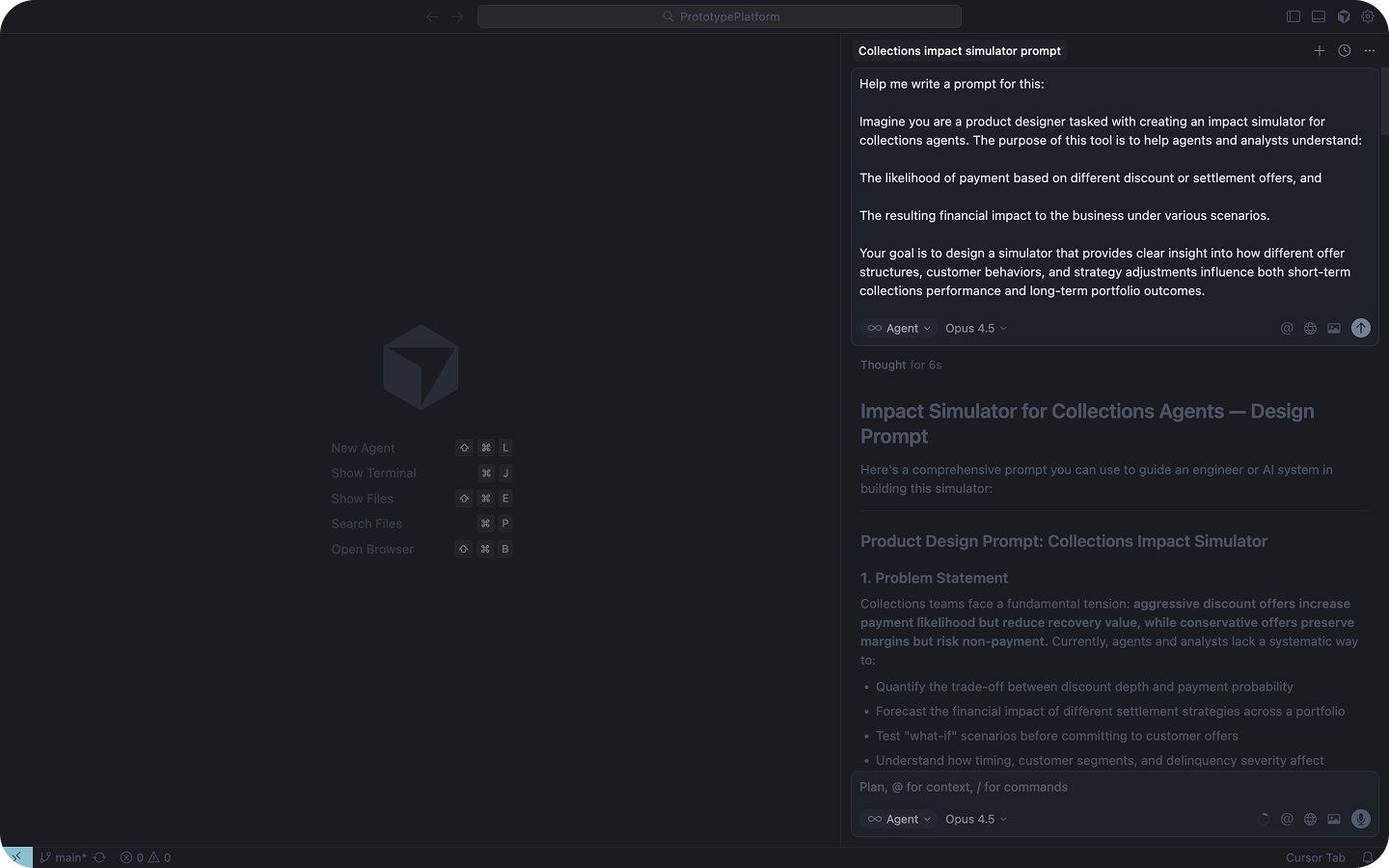
In enterprise work, requirements are often incomplete or abstract. I’ve used vibe coding to turn vague ideas into visual hypotheses — for example, building a simple impact simulator to explore “what if” scenarios.
These aren’t final solutions. They’re thinking tools that make ambiguity visible and debatable.
3. Synthesizing call transcripts into action
Uploading call transcripts and using AI to extract themes, next steps, and task breakdowns has saved significant time. More importantly, it helps translate raw input into something the team can act on quickly.
This supports design work rather than replacing it.
4. Clickable competitive analysis
Instead of static slides, I’ve used vibe coding to create quick, clickable competitive walkthroughs. Stakeholders engage more deeply when they can interact with patterns instead of just reading about them.
Again, these are not production artifacts — they’re conversation starters.
I don’t treat vibe coding as a replacement for design fundamentals. I treat it as a thinking accelerator.
Here’s how I keep it grounded:
Most importantly, I apply judgment. Just because something can be generated doesn’t mean it should be.
Vibe coding doesn’t eliminate the design process — it adds a new lane.
Used well, it helps:
Used poorly, it creates noise, confusion, and mistrust.
The difference is intent.
Designers should use vibe coding when:
Designers should not use vibe coding when:
To introduce it safely in a mature organization:
Vibe coding isn’t the future of design. Designers are. Tools will keep changing. Our responsibility — to think clearly, make good decisions, and collaborate well — doesn’t.
That’s where the real value still lives.